
 Post by
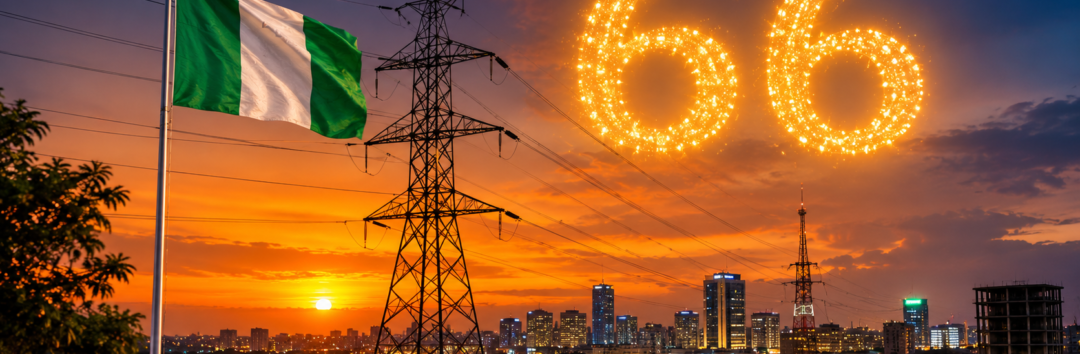
Nigeria marked its 66th Independence Day on October 1, and Nigeria power sector progress featured in the anniversary coverage. A Radio Nigeria feature used the anniversary to trace the road from darkness to reliable power. In 1960, the national grid carried “less than 100 megawatts of electricity for a population of about 45 million people.” On September 22 this year, it generated about 5,403MW. That is real progress. It is also worth asking how far 66 years should have taken us.
So instead of one verdict, here is a report card with four numbers.
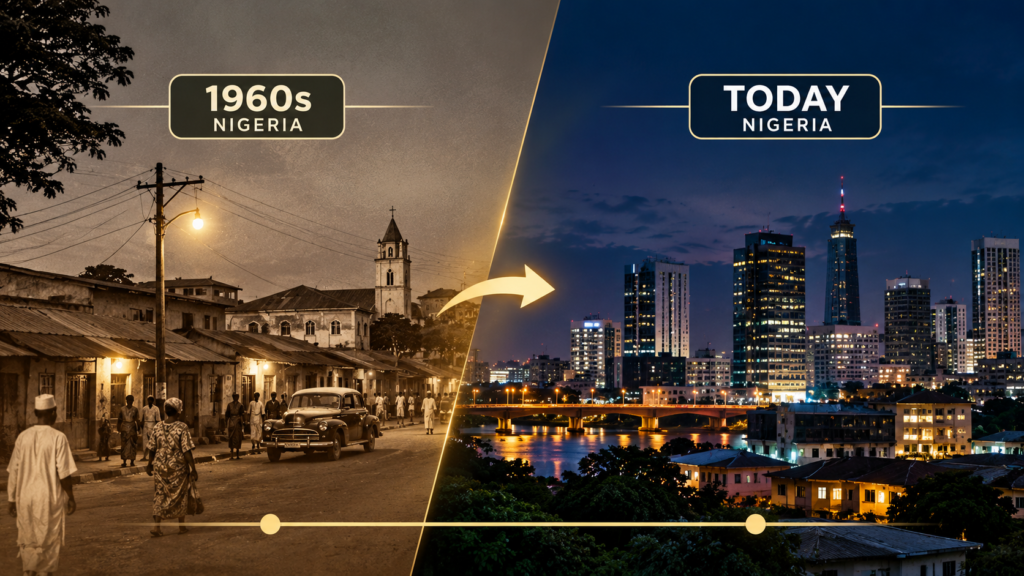
generation: from under 100MW To about 5,403MW
The gain is large. In 1960, under 100MW served roughly 45 million people, which works out to at most about 2 megawatts per million Nigerians. Today’s 5,403MW serves a population of more than 200 million, or around 27 megawatts per million. That is at least a twelvefold improvement per person. Generation peaked at about 5,801MW in March 2025, and the Power Minister’s first 100 days saw output stay above 5,000MW and peak at 5,330MW in August and September.
Delivery: 4,379MW reached the DisCos
Generation isn’t delivery. Of the 5,403MW on September 22, about 4,379MW reached the eleven distribution companies. The Transmission Company of Nigeria reports 66 new power transformers and a 76% drop in grid disturbances over five years. Even so, the grid recorded more than 100 collapses between 2015 and 2022, and generation fell to 1,132MW during a partial collapse in August.
metering: roughly half the customers
The government’s own count says over 7 million customers have meters, and more than 7 million do not. An unmetered customer can’t see what they use or pay for, and a utility can’t bill them accurately. Until that gap closes, the revenue that should fund better service keeps leaking.

reform: real changes, slow results
The 2023 Electricity Act ended the Federal Government’s monopoly on the market, and fifteen states have since activated their own electricity markets. The government says reform has drawn over $2 billion in private investment and mobilised ₦1.23 trillion toward a ₦3.3 trillion power sector debt. Those moves matter. But the Radio Nigeria feature itself admits the real test: “The challenge is no longer simply generating more electricity.” The measure of progress, it says, is “how many hours of electricity are available each day?”
what the president’s speech said about power
President Tinubu’s anniversary speech touched on electricity only briefly. He promised that “we will use our gas to power new industries” and described a Nigeria “in which factories have reliable power.” Daily Trust noted that he gave no detailed plan for lowering electricity costs or improving supply to households.
the grade that matters to your home
Nigeria power sector progress is real, and it is uneven. The national numbers can climb while your street still loses power for hours. The sector’s own yardstick, hours of supply each day, depends on your feeder, not on the national average.
You can’t wait for the next 66 years of reform to reach your street. A solar and battery system gives your household its own hours of supply, whatever the national table says.
Get a free load assessment at the Maektech Online Shop, or reach out for a consultation. Celebrate the progress, and keep your own lights on while the country catches up.